Can a Power Station Run a Dehumidifier After a Flood?
This article contains affiliate links: if you buy through them, we earn a small commission at no extra cost to you. It never changes our verdict — our research method is public. See how we research
Here’s the answer before the caveats, because you’re probably standing in a wet room right now: yes, a power station can run a dehumidifier, as long as it beats the unit’s running watts and its startup surge. Most residential dehumidifiers pull 300 to 700W running, with a compressor spike of 600 to 1,200W when they kick on — a 1,500W-continuous, 3,000W-surge power station clears both numbers easily.
The part the sales pages skip is runtime. A dehumidifier is a much hungrier houseguest than a refrigerator, and a single charge on a 1,000Wh-class battery buys you a couple of hours, not a full day. If you’re racing the clock on flood mold, that gap between “it can run one” and “it can run one long enough” is the whole decision.
The clock you’re actually racing
This only matters because of a number that has nothing to do with watts. The CDC’s disaster guidance is specific: clean up and dry out a home fully within 24 to 48 hours after a flood, and if you weren’t able to get materials dry inside that window, assume mold growth is already underway. The EPA says the same thing in its own worker and homeowner guidance — wet building materials should be dried within 24 to 48 hours, full stop.
Restoration industry data fills in what happens if you miss it: mold spores that land on a damp surface typically germinate within that same 24-to-48-hour stretch, and visible colonies can show up by the 48-to-72-hour mark. Past 72 hours, water damage is generally treated as needing professional-grade remediation rather than a fan and an open window. None of that is medical advice — it’s a drying deadline, and it’s the reason “can I power a dehumidifier” is a more urgent question after a hurricane than it looks on a spec sheet.
How many watts a dehumidifier actually pulls
Ignore the amperage printed on the unit’s nameplate — like a fridge’s door sticker, it’s a maximum safety rating, not what the machine draws sitting in your living room. Real running draw depends on capacity:
- Compact 30-pint units (the kind sized for a bedroom or small basement corner) typically run 300 to 400W.
- Mid-size 50-pint units — the workhorse for a flooded basement or a whole downstairs — run higher. Frigidaire’s FHDP5033Y1, a common 50-pint model with a built-in pump, is rated around 470 to 590W across its variants.
- Startup surge adds on top of that. A compressor kicking on briefly draws 1.5 to 3 times the running wattage, which puts most residential units in a 600 to 1,200W surge range for a second or two.
Trust the running and surge numbers over the nameplate max, and add margin above the highest of each — that’s the whole rule before you plug anything expensive into a battery you’re trying to protect.
Matching a power station to that surge
Both machines I keep coming back to for this power-and-grid cluster clear a dehumidifier’s numbers without drama. The Jackery Explorer 1000 v2 runs 1,500W continuous with a 3,000W surge rating; the EcoFlow DELTA 3 runs 1,800W continuous (2,200W with X-Boost) and surges to 3,600W. Either one is roughly double the worst-case dehumidifier surge you’ll encounter in the 50-pint class, which means the inverter isn’t the thing that fails here — I ranked the two head-to-head on surge headroom for compressor appliances generally in my best power station for refrigerator backup comparison, and the same ranking holds for a dehumidifier’s compressor.
What fails is the fuel gauge. I ran this exact division for a refrigerator in how long a power station will run a refrigerator, and a fridge is the generous case — it cycles on and off, averaging maybe 50 to 90W over a full day. A dehumidifier pulling moisture out of a flooded room runs its compressor far more continuously, closer to its full running wattage for hours at a stretch.
Do the same three-step math from that fridge article, this time for a dehumidifier: a 1,070Wh Jackery discounted for inverter loss delivers about 900 usable watt-hours. Divide that by a 450W average draw — a reasonable middle point between a 30-pint and a 50-pint unit — and you get roughly 2 hours of runtime per charge. The EcoFlow DELTA 3’s 1,024Wh pack lands in the same neighborhood, closer to 1.8 hours. Compare that to the fridge’s 12-to-18-hour figure from the same battery class, and the difference is entirely about duty cycle: a fridge coasts, a dehumidifier working a soaked room does not.
Why 2 hours isn’t nothing, but it isn’t the answer either
Two hours per charge sounds thin against a 24-to-48-hour drying deadline, and it is, if you’re expecting one battery to do the whole job unattended. But it’s not useless:
- It buys you the worst part of day one — running the dehumidifier hard through the hours right after the water recedes, before you’ve sourced anything bigger, matters more than the same two hours on day three.
- Pass-through solar changes the math. Both units accept 400-500W of panel input with pass-through charging, so a sunny post-storm afternoon can roughly double or triple what one “charge” actually covers.
- It’s a bridge, not a substitute, for a generator or restored grid power if you’re drying more than one room or racing the full 48-hour window without other power sources.
If your plan is whole-house drying with zero outside power for two straight days, be honest with yourself about what a single 1kWh-class battery buys: a few focused hours, not the marathon. That’s not a knock on the hardware — it’s the same gap between “can run it” and “can run it long enough” that shows up anywhere a compressor appliance meets a battery built for overnight duty, not round-the-clock extraction.
Running it safely in a just-flooded space
This is gear guidance, not a substitute for the dehumidifier’s manual or a licensed electrician’s judgment about a specific flooded structure — read both before you plug in.
- Keep the power station itself out of standing water and off a wet floor. Elevate it on a dry shelf or a plastic bin lid; these are sealed batteries, but the outlets and cords are not swim gear.
- Use a GFCI-protected outlet or power strip between the station and the dehumidifier whenever the surrounding area is damp — most current power stations already include GFCI-equivalent protection on their AC outlets, but check the manual for your specific unit.
- Don’t overload the same outlet bank running a dehumidifier alongside fans or a sump pump; check the combined running watts against the station’s continuous rating, not just the dehumidifier’s alone.
- Empty the water tank or confirm continuous drain routing before you leave it running unattended — a full tank shutoff means hours of runtime spent for nothing.
When this becomes a job for a professional, not a battery
I stay in gear and specs here, not health advice, so here’s the line as CDC and EPA draw it, not as I’d guess it: the EPA’s rule of thumb is that visible mold covering more than 10 square feet — roughly a 3-by-3-foot patch — calls for a professional remediation contractor rather than DIY cleanup. Below that threshold, both agencies’ homeowner guides cover doing it yourself. And anyone in the house with asthma, COPD, allergies, or a weakened immune system shouldn’t be the one running the cleanup regardless of square footage — that’s CDC guidance, not mine to soften or override.
A power station and a dehumidifier are tools for keeping a small, fresh water event from turning into that 10-square-foot problem in the first place. They’re not the tool for remediating one that’s already there.
Who this is for — and who should skip it
Get a power station for this job if you’re drying one room — a bedroom closet, a small basement corner, the spot under a leaking window — in the hours right after water recedes, especially if grid power isn’t back yet and you can supplement with solar or a car charger through the day. Pair it with the CO-safety math in my piece on power stations vs. generators after a storm — the generator question is about exhaust; this one is about racing mold, and a battery that produces zero carbon monoxide is the easier tool to run indoors, right next to the wet spot, without a second thought about ventilation.
Skip the power station and lean on a generator or restored grid power if you’re drying a whole flooded basement or a multi-room ground floor across the full 24-to-48-hour window — that’s more continuous wattage than a 1kWh-class battery was ever built to deliver without near-constant recharging. If the flood is one piece of a bigger outage plan, my emergency preparedness checklist for apartments walks through the rest of the house, not just the drying problem.
Skip both and call a restoration contractor if the water sat more than 48 hours before anyone could act, or if visible mold is already past that 10-square-foot mark. At that point the honest move isn’t a bigger battery — it’s the phone number in EPA’s guide.
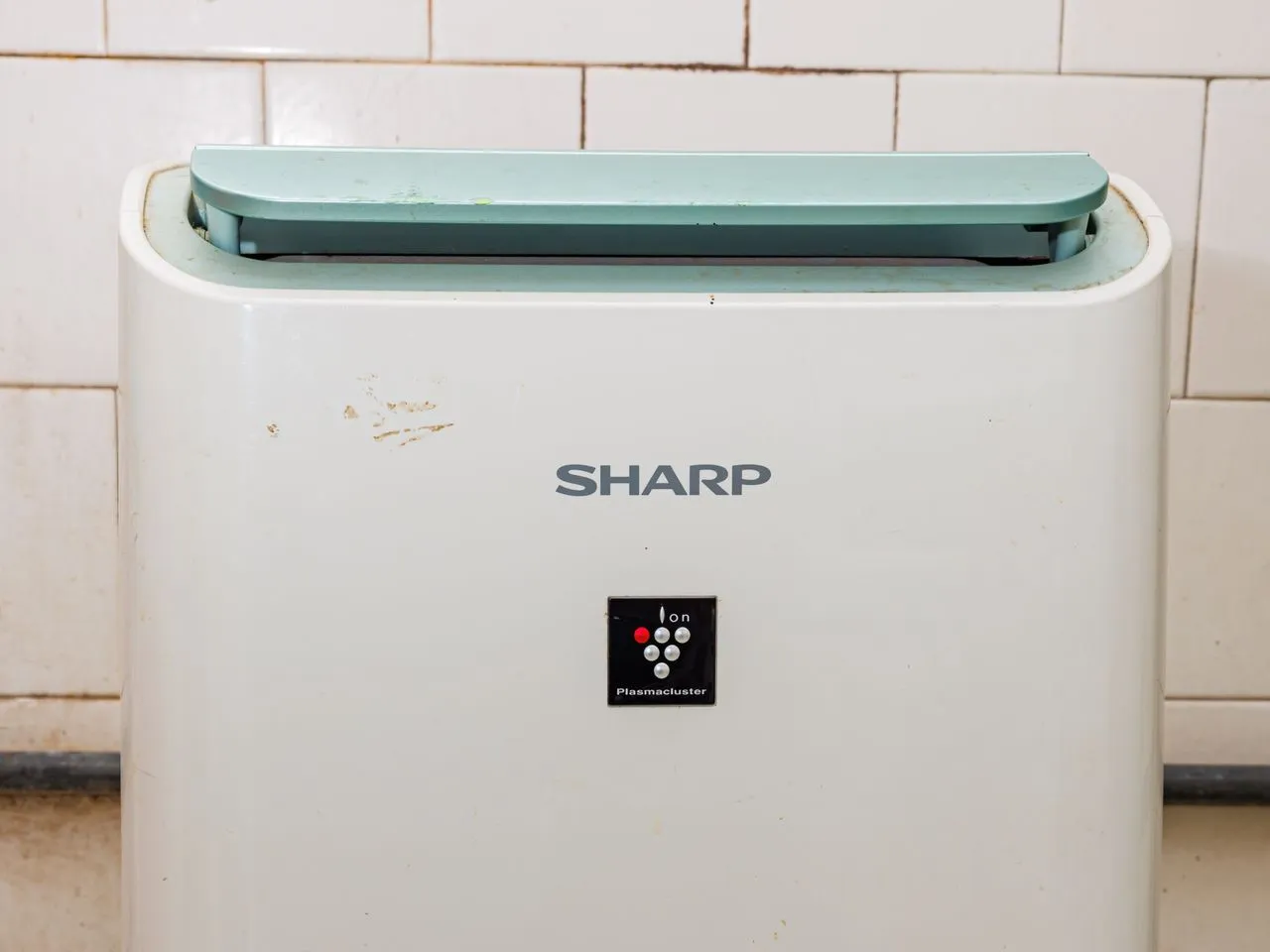
Cover photo: “Sharp Dehumidifier DW-CE15F-W, front side” by Dinkun Chen, via Wikimedia Commons, licensed under CC BY-SA 4.0.
Frequently asked questions
Can a power station run a dehumidifier?
Yes, if it clears two specs: continuous output above the dehumidifier's running watts (usually 300-700W) and surge capacity above its startup spike (600-1,200W). A 1,500W-continuous, 3,000W-surge power station like the Jackery Explorer 1000 v2 or EcoFlow DELTA 3 clears both with room to spare.
How many watts does a dehumidifier use?
Most residential dehumidifiers run at 300 to 700 running watts depending on capacity — a compact 30-pint unit lands nearer 300-400W, while a 50-pint whole-basement model like Frigidaire's FHDP5033Y1 draws around 470-590W. All of them briefly spike 1.5 to 3 times higher when the compressor starts.
How long will a power station run a dehumidifier on one charge?
A 1,000Wh-class power station delivers around 2 hours of dehumidifier runtime per charge, after accounting for inverter losses. That number comes from usable watt-hours (roughly 900) divided by a typical 450-500W draw — far shorter than the 12-18 hours the same battery gives a refrigerator.
How fast does mold grow after a flood?
According to the CDC and EPA, mold can begin growing within 24 to 48 hours on anything left wet, and if materials stay damp past 48 hours you should assume mold is already present. Restoration industry data puts visible colonies forming by the 48-to-72-hour mark, which is why speed matters more than any single piece of gear.
Do I need a generator instead of a power station to dry out a flooded room?
For a single room over a few hours, a power station works fine. For whole-house drying across the full 24-to-48-hour CDC window without grid power, a generator or a power station paired with solar recharge is the more realistic tool — a battery alone typically can't refill fast enough to keep pace.
When does flood mold need a professional instead of DIY cleanup?
The EPA's rule of thumb is 10 square feet of visible mold — roughly a 3-by-3-foot patch. Below that, EPA's homeowner guide covers DIY cleanup. Above it, or for anyone with asthma, COPD, or a weakened immune system, EPA and CDC both recommend a professional remediation contractor instead.