How Long Will a Power Station Run a CPAP?
This article contains affiliate links: if you buy through them, we earn a small commission at no extra cost to you. It never changes our verdict — our research method is public. See how we research
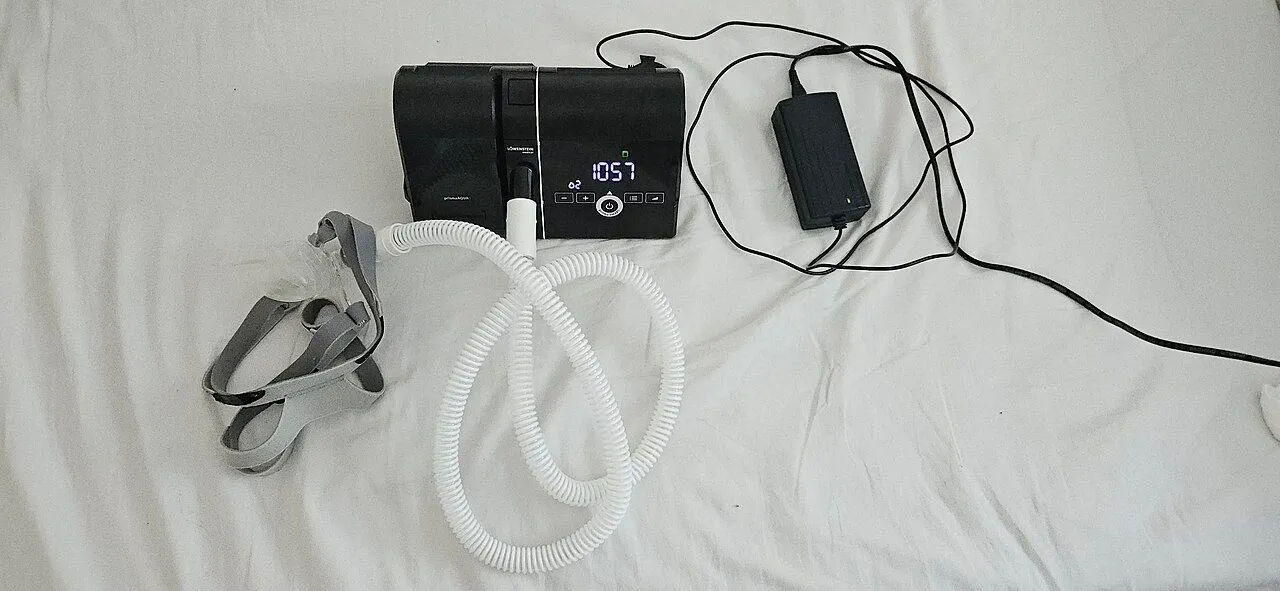
Here’s the answer up front, because if you’re reading this you’re probably sizing a battery for someone whose sleep depends on it: a 1,000Wh-class portable power station will run a typical CPAP for two to three nights with the heated humidifier and climate tube on — and for about a week of nights with them off. The machine itself is a featherweight. The comfort features are the whole bill.
Almost every runtime guide on this topic is written by the company selling you the battery, and almost all of them plan around “30 to 60 watts” without telling you where the number comes from. There’s a better source: the manufacturer of the most common CPAP platform in America published a lab-measured consumption table, and nearly nobody quotes it. So let’s quote it, run the honest math, and figure out how many nights your shelf actually holds.
How many watts a CPAP actually uses — the table nobody quotes
ResMed’s “Power consumption of Air10 devices” document reports bench measurements taken with a breathing simulator and a lab power meter — real therapy load, not marketing guesswork. For an AirSense 10 AutoSet running a typical pressure profile, the numbers per hour of use are:
- Device only (humidifier and heated tube off): about 7W
- Device plus heated humidifier (setting 6): about 22W
- Device plus humidifier plus ClimateLineAir heated tube: about 34W
- Standby, screen dark, doing nothing: about 5W
Read that list twice, because it’s the entire article in four lines. The blower that actually delivers therapy pressure sips 7 watts — less than a night light. Switching the heated humidifier on triples the draw. Adding the heated tube brings it to roughly five times the bare machine. Bilevel machines run a little hotter (ResMed’s same table puts an AirCurve 10 VAuto at 9W bare and 41W fully loaded), but the shape of the story is identical: the comfort features are the load.
So where does the internet’s “CPAPs draw 60 watts” come from? From the wall adapter. The AirSense 10 ships with a 90W power supply, and its user guide lists 53W typical and 104W peak — figures that describe what the electronics can demand for moments (warming a cold humidifier tank, spinning up against a mask leak), not what they average across eight hours. Sizing your battery from the brick is like sizing a water tank from the diameter of the faucet. The newer AirSense 11 moved to a 65W supply, and owners metering it on forums like CPAPtalk report single-digit draws with comfort features off — same story, slightly better.
From battery label to nights — the three-step math
Same arithmetic I use for refrigerators during an outage, with smaller numbers.
Step 1 — pick your real wattage. Off the table above: 7W bare, 22W with humidifier, 34W with humidifier and heated tube. If you run a bilevel machine, nudge each number up a few watts.
Step 2 — discount the battery. The advertised watt-hours describe the cells, not what reaches your nightstand. Running through the AC inverter, plan on about 85% of rated capacity doing useful work. A 1,070Wh station delivers roughly 910 usable watt-hours; a 1,024Wh station about 870.
Step 3 — divide, then divide by eight. Usable watt-hours ÷ watts = hours; hours ÷ 8 = nights.
There’s one wrinkle unique to loads this small, and it’s the part the battery brands skip: the inverter itself eats a share. Any power station keeps a few watts of housekeeping draw going just to hold its AC outlets live — owner meter tests on 1,000Wh-class units consistently land that overhead in the mid-single digits to low teens. Against a refrigerator’s 74W average, nobody notices. Against a CPAP’s 7W, the inverter can quietly consume as much as the therapy. That’s why my night counts below assume the machine plus overhead, and it’s why the DC trick in the next section is worth your attention.
Run the math with overhead included and a 1,070Wh station lands here:
- Humidifier + heated tube (~42W at the wall): about 21 hours — call it 2 to 3 nights
- Humidifier only (~30W): about 30 hours — 3 to 4 nights
- Bare machine (~15W with overhead): about 60 hours — a solid week of 8-hour nights
The inverter tax, and why DC is the CPAP cheat code
Every watt-hour in that battery is stored as DC. Your CPAP’s circuit board runs on DC. Running the AC inverter means converting DC to AC at the station, then AC back to DC in the power brick — two conversions, both losing energy, plus that idle overhead, all night long.
CPAP makers quietly solved this years ago for campers and truckers: dedicated DC converters. ResMed’s Air10 DC-DC converter takes 12 or 24 volts from a car-style socket and feeds the machine directly, rated to the same 90W ceiling as the wall brick and compatible with the humidifier and heated tube. Plug that into the power station’s regulated 12V car port and the AC inverter stays off entirely. On the bare machine, the DC path roughly doubles your nights — the same 1,070Wh battery pencils out to two weeks of humidifier-off sleep instead of one. Even fully loaded, you gain about an extra night.
Two cautions from the spec sheets. First, use the machine brand’s own converter — the connector and voltage are proprietary, and the cheap universal adapters are where the horror stories live. Second, if you do run AC, both units below produce pure sine wave power, which is what a humidifier’s heater plate wants; the crude modified-sine inverters sold for cars are the one genuinely risky path.
Two real machines through the math
Same two 1kWh-class volume sellers I used for the fridge math, because their spec sheets are public and their surge ratings make them boring — in the good way — for a load this gentle.
EcoFlow DELTA 3 — 1,024Wh LiFePO4, and the headline feature for this exact job: a UPS mode with sub-10-millisecond switchover. Leave the DELTA 3 plugged into the wall, leave the CPAP plugged into the DELTA 3, and a 2 a.m. outage never reaches the mask — the battery picks up the load faster than the machine can notice, and you find out the grid failed when you check the app over coffee. For a device you’re asleep behind, that’s not a convenience feature; it’s the feature. About 870 usable watt-hours: 2 to 3 fully-loaded nights, near 7 with comfort features off.
Jackery Explorer 1000 v2 — 1,070Wh LiFePO4, 23.8 lbs, the lightest of the big-name 1kWh class, with slightly more capacity and a marginally better night count. The honest catch: no pass-through UPS mode. If the grid drops mid-night, the CPAP stops until someone plugs it into the Jackery. As a planned setup — sleep on the battery, recharge it by day — it’s excellent; as an automatic safety net, the EcoFlow’s architecture simply fits sleep gear better.
Both carry LiFePO4 packs rated for 4,000 charge cycles, which matters for a box that spends 360 days a year waiting on a shelf. Expect around $450 to $800 for the Jackery depending on sales, and around $550 to $700 for the DELTA 3.
Stretching the nights when the outage outlasts the plan
- Decide the humidifier question before the storm, not at midnight. The math above makes the trade obvious — three nights versus one week is almost entirely that one setting. Whether you sleep acceptably without humidification is a question for your sleep clinic, not for a gear blog; I’m here for the electricity math only. Ready.gov’s guidance says the same thing more formally: talk to your provider ahead of time about a power-outage plan for any medical device you rely on.
- Go DC if your machine’s maker sells a converter. Biggest single efficiency win available, and it travels well.
- Refill by day. Every current 1kWh unit accepts solar and car charging. A CPAP night costs 60 to 340 watt-hours — a 100W panel in decent summer sun replaces the humidifier-off version before lunch, and a drive to check on the neighbors tops it off from the car port.
- Keep the station topped off and the firmware’s standby drain in mind. A battery at 60% because nobody checked it since spring is the most preventable failure in this whole plan. Mine gets a line on the same checklist as the smoke detectors.
Preparedness is insurance, not fear — and this particular policy is cheap: one measured table, one honest division, and a battery you already wanted for the refrigerator.
Who needs a power station for a CPAP — and who should skip it
Get one if someone in your house sleeps on CPAP and your outages run hours to days: tornado alley (my sirens and I sympathize), hurricane season, wildfire shutoffs, rural lines. The 1,000Wh class is the sweet spot — a week of lean nights, two to three comfortable ones, silent and legal in a bedroom where a generator never will be. If outages at your address routinely pass 48 hours, either step up to 2kWh-plus or add a solar panel rather than pretending the math says otherwise.
Skip it if you only see a few blinks a year — a purpose-built CPAP travel battery (usually 90 to 200Wh) covers a single night for less money and fits in the nightstand drawer. And skip the temptation to buy one battery for everything in a long outage: a station running the fridge by day and the CPAP by night is doing two jobs on one charge, and my apartment preparedness checklist covers the planning layers that decide which job wins before you’re choosing in the dark.
If a sales page quotes you a CPAP runtime without naming the humidifier setting, you now know exactly which question to ask it.
Frequently asked questions
How many watts does a CPAP machine use?
Far less than the power brick suggests. ResMed's own lab table puts an AirSense 10 AutoSet at about 7 watts with comfort features off, 22 watts with the heated humidifier, and 34 watts adding the heated tube. The 90-watt supply is peak capability, not what the machine draws all night.
Will a 300Wh power station run a CPAP overnight?
Yes — comfortably, if the humidifier stays off. At roughly 7 to 15 watts of real draw, a 300Wh unit covers one to two full nights through its inverter. Turn the heated humidifier on and one night gets tight; add the heated tube and you may not reach morning.
Can I run a CPAP directly from a power station's DC port?
Yes, and it's the most efficient option. Manufacturers sell DC converters — ResMed's Air10 unit accepts 12 or 24 volts and plugs into a car-style port — which skip the AC inverter entirely. Cutting that conversion, plus the inverter's own idle draw, can add a night or more of runtime.
Does the heated humidifier really drain the battery that much?
Yes — it is the single biggest factor. In ResMed's measured table, switching the humidifier on triples the draw from 7 to 22 watts, and the heated tube pushes it to 34. That turns a week of battery nights into two or three. Nothing else you change comes close.
Will a power station switch over if the power fails while I sleep?
Only if it has a UPS or EPS mode. The EcoFlow DELTA 3 switches in under 10 milliseconds when it sits between the wall and the CPAP, so the machine never stops. The Jackery Explorer 1000 v2 has no pass-through UPS mode — you would plug in after waking.
What size power station do I need for a week of CPAP nights?
With comfort features off, a 1,000Wh-class station already covers about a week of eight-hour nights. With the humidifier and heated tube on, a full week means 2,000 to 3,000Wh of battery — or a 1,000Wh unit plus a 100 to 200W solar panel to refill it every day.