Best Power Station for Refrigerator Backup, Ranked by Surge
This article contains affiliate links: if you buy through them, we earn a small commission at no extra cost to you. It never changes our verdict — our research method is public. See how we research
A refrigerator holds a couple hundred dollars of food and a week of dinner plans, and it only asks for two things from a backup battery: enough surge to start the compressor, and enough watt-hours to keep it cycling until the grid comes back. Nearly every buying guide obsesses over the second number. The first one is where power stations actually fail.
So this ranking works the other way around. Surge first, capacity second, and the honest practicalities — pass-through, weight, recharge speed — as tiebreakers. It’s also a short list on purpose: two machines, not nine. These are the volume sellers of the 1kWh class, their spec sheets are public and complete, and they’re the same two units I already ran through the runtime arithmetic in my guide to how long a power station will run a refrigerator. A list padded to seven with units nobody should buy isn’t a ranking; it’s shelf filler.
The spec that actually fails: compressor startup surge
While it’s running, a household fridge is a light load — 100 to 250W with the compressor on, and far less averaged over a day of cycling. If running watts were the whole story, a beach-cooler-sized battery could do this job.
Startup is the whole story. A compressor is an induction motor, and for the first second or two it demands two to four times its running draw — commonly 800 to 1,200W on a full-size fridge. The authoritative number for your fridge is stamped on the compressor nameplate as LRA, locked rotor amps: multiply by 120V and that’s the worst-case spike your inverter must ride out. Restarting against pressure — compressor kicks off and immediately back on, refrigerant still compressed — asks for even more torque, which is exactly the moment a marginal inverter gives up.
An inverter that can’t cover the spike doesn’t dim the lights and soldier on. It trips and shuts off to protect its electronics, and your fridge sits dark until you notice. That’s the failure filling solar-forum complaint threads, and it’s almost always a small station asked to do a fridge’s job. The fix is boring: buy surge headroom of at least double your fridge’s startup spike. Both units below clear that bar with room to spare.
How I ranked the best power stations for fridge backup
Five criteria, weighted in this order:
- Surge headroom. The rating that decides whether the compressor starts, every single cycle, including hot restarts.
- Continuous output and wave quality. Pure sine wave only — a compressor motor on a choppy modified sine wave runs hot and dies young.
- Pass-through behavior. Can the fridge live plugged in through the station, so the outage never touches it? UPS mode is the difference between backup and a chore.
- Usable capacity. Rated watt-hours minus roughly 15% inverter loss — the number that actually reaches the fridge.
- The practical stuff. Weight up basement stairs, recharge speed, solar ceiling, cycle life of the chemistry.
| Product | Score | Highlight | Price range | Buy |
|---|---|---|---|---|
| Top pick EcoFlow DELTA 3 | 8.8 | 1,024Wh with sub-10ms UPS switchover — the fridge never notices the outage | around $550 to $700 | EcoFlow |
| Jackery Explorer 1000 v2 | 8.6 | 1,070Wh LiFePO4 in a 23.8 lb box — lightest of the big-name 1kWh class | around $450 to $800 | Jackery |
1. EcoFlow DELTA 3 — best power station for refrigerator backup
The DELTA 3 wins on the criterion most rankings never mention: it can sit between the wall outlet and the refrigerator full-time. EcoFlow’s spec sheet rates its UPS switchover at under 10 milliseconds — when the grid drops, the fridge rides through without so much as a clock reset. Backup that requires you to be home, awake, and paying attention isn’t really backup; the DELTA 3 removes the human from the loop entirely. It’s the same pass-through trick that made it my pick for running a CPAP through an outage, and a fridge is an even more forgetful appliance than a sleeper.
The raw numbers lead the class too: 3,600W of surge and 1,800W continuous from a 1,024Wh LiFePO4 pack rated for 4,000 cycles. That surge figure is roughly triple what a typical full-size fridge demands at startup — enough margin for a hot restart, an old compressor, or the freezer in the garage joining the party on one of its six AC outlets. It refills from the wall in under an hour, takes up to 500W of solar, and after inverter losses delivers about 870 usable watt-hours: 12-ish hours on a typical fridge running straight through, most of a day or more if you cycle it.
One honest flag on the spec sheet: X-Boost, the mode that stretches output to 2,200W, does it by lowering voltage — a trick EcoFlow’s own documentation points at kettles and heaters, not motors. Low voltage makes a compressor draw more current and run hotter. For fridge duty, ignore the boost number; the native ratings are the ones doing the work, and they’re plenty. The real costs are 27.6 lbs of two-handed carry and cooling fans that owner reviews consistently describe as audible during fast charging — in a kitchen, you’ll hear it top up.
Pros
- True UPS mode with sub-10ms switchover — leave the fridge plugged in and outages become invisible
- 6 AC outlets and 13 ports total, so the fridge, router, and phones share one box
- 3,600W surge plus 1,800W continuous is the most output headroom in the 1kWh class
Cons
- At 27.6 lbs it is noticeably heavier than the Jackery — a two-hands carry up basement stairs
- Cooling fans are clearly audible during fast charging, a consistent theme in owner reviews
- USB-A ports are capped at a dated 18W — phones fast-charge only on the USB-C side
2. Jackery Explorer 1000 v2 — best if you’ll carry it
The Explorer 1000 v2 answers the fridge question nearly as well and the doorway question better. Its 3,000W surge and 1,500W continuous clear any household compressor with the same comfortable margin, the 1,070Wh LiFePO4 pack is rated for 4,000 cycles on Jackery’s spec sheet, and at 23.8 lbs it’s the lightest full-power unit in the class — almost four pounds under the DELTA 3, which matters more than it sounds when the outage plan involves basement stairs or a truck bed. Slightly more capacity also means slightly more runtime: about 910 usable watt-hours, good for 12 to 18 hours of continuous fridge coverage depending on what’s in your kitchen.
What it lacks is the DELTA 3’s whole party trick. There’s no UPS mode — the Explorer can’t sit inline waiting for the grid to fail, so backup means noticing the outage and plugging the fridge in. Thanks to the closed fridge’s roughly four-hour grace window (FoodSafety.gov’s figure), that’s rarely fatal at 2 p.m. and easily fatal on night two of an ice storm when the power blinks while everyone’s asleep. Its app-enabled emergency mode does refill the battery in about an hour, the 400W solar ceiling trails EcoFlow’s only modestly, and Jackery’s frequent sales regularly make it the cheapest certified-spec path to fridge coverage. As a grab-and-go unit that also does fridge duty, it’s the better buy. As an appliance that guards the fridge unattended, it can’t.
Pros
- Lightest full-power option in the 1kWh class at 23.8 lbs — nearly 4 lbs under the DELTA 3
- 3,000W surge rating clears any household fridge compressor startup with huge margin
- LiFePO4 pack rated for 4,000 cycles, so shelf-sitting backup duty barely ages it
Cons
- No UPS mode — you plug the fridge in after the outage starts, not before
- Only one USB-A port, and the solar input ceiling (400W) trails EcoFlow's 500W
- List price runs high; it only beats the DELTA 3 on value during Jackery's frequent sales
When 1,000Wh isn’t enough — the honest step-up guide
Both units above are sized for the common case: outages measured in hours, up to about a day with door discipline and cycling. Some situations genuinely outgrow them, and no amount of brand loyalty changes the arithmetic.
- Outages that routinely pass 24 hours: move to the 2,000Wh class. Same surge math, double the marathon. The DOE’s appliance data puts a typical fridge near 650 kWh a year — about 1.8 kWh a day — and a 2kWh battery covers a full day of that with margin.
- Multi-day grid failures: 3,000Wh-plus, or any of these stations plus 200 to 400W of solar panels. Every current unit in this class supports pass-through charging, and a panel turns “hours of runtime” into “as long as the weather cooperates.”
- The whole kitchen plus the well pump: that’s transfer-switch and standby-generator territory, not portable-battery territory, and an electrician’s conversation rather than a checkout button. A power station protects groceries and phones; it doesn’t run a house.
Preparedness is insurance, not fear — and like any policy, the right coverage is the one matched to your actual risk, not the biggest number on the shelf. If your outages are three twenty-minute blinks a year, the fridge’s own thermal buffer already covers you for free, and I’d put the first few hundred dollars elsewhere — my emergency preparedness checklist for apartments is where I’d start that budget instead.
Who each pick is for — and who should skip both
Buy the EcoFlow DELTA 3 if the fridge is the mission. UPS pass-through means the outage is handled before you know it happened, the surge headroom is the largest in the class, and six outlets keep the router and phones on the same box. It’s the one I’d assign to the kitchen and never think about again.
Buy the Jackery Explorer 1000 v2 if the same battery must also camp, tailgate, and ride to the in-laws’ place — and someone’s home to plug the fridge in when the lights go out. Lighter, a shade more runtime, and frequently cheaper on sale.
Skip both if your outages are rare and short — the closed fridge’s four-hour buffer handles those unassisted. Skip the whole 1kWh class if you’re backing up medical equipment or a household for days; that’s honest 2-to-3kWh-and-solar money, and stretching a smaller battery there just means a warm fridge at hour fifteen. And if a sales page needs a collapsing grid to close the deal, close the tab instead — the ordinary ice storm is reason enough, and it has the advantage of actually happening.
If a generator is still on the table for that longer outage, read the placement rules first — the CPSC’s 20-foot clearance fails more often than people expect, and I broke down exactly why (and when a battery is the safer call instead) in power station vs. generator carbon monoxide safety.
Prices checked on 7/27/2026 and subject to change. Confirm the current price at the store.
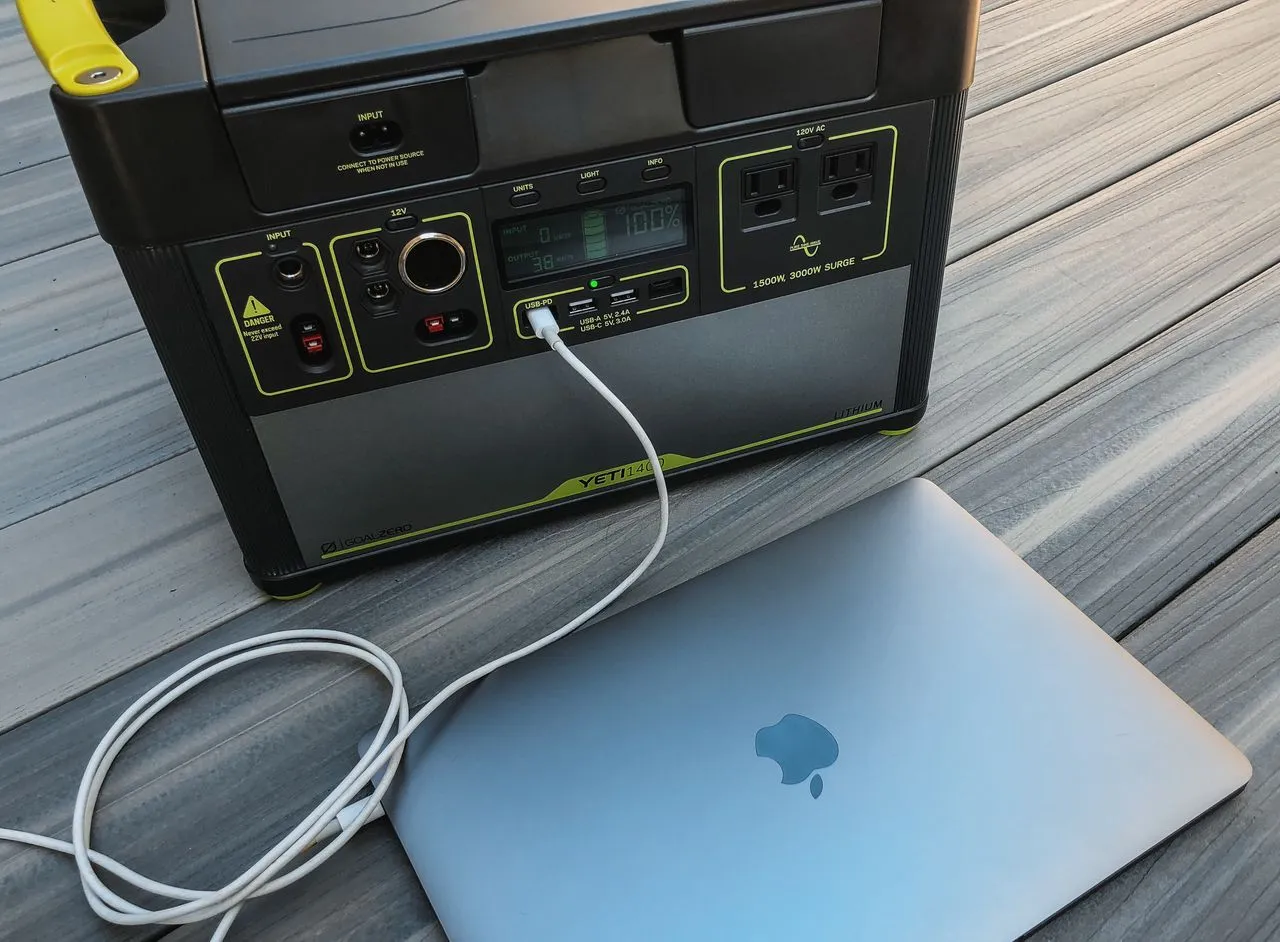
Cover photo: “Goal Zero Yeti 1400 Lithium Portable Power Station” by Tony Webster, via Wikimedia Commons, licensed under CC BY-SA 2.0.Frequently asked questions
Why does surge wattage matter more than watt-hours for a fridge?
Watt-hours decide how long the fridge runs; surge watts decide whether it runs at all. A compressor briefly demands two to four times its running draw at startup — often 800 to 1,200W. An inverter that cannot cover that spike shuts down to protect itself, no matter how big the battery behind it is.
Do I need a pure sine wave inverter to run a refrigerator?
Yes. Compressor motors expect the smooth wave the grid delivers; modified sine wave inverters make them run hotter and louder and can shorten their life. Every current 1kWh-class station from the major brands — including both units ranked here — outputs pure sine wave, so this mostly matters when buying used or bargain-bin.
Can I leave the fridge plugged into a power station all the time?
Only if the station has a UPS or EPS pass-through mode. The EcoFlow DELTA 3 sits between the wall and the fridge and switches over in under 10 milliseconds when the grid drops. The Jackery Explorer 1000 v2 has no UPS mode — you plug the fridge in after the outage starts.
Will EcoFlow's X-Boost mode help start my refrigerator?
No — do not count on it. X-Boost raises apparent capacity by lowering output voltage, which suits resistive loads like kettles and heaters. A compressor fed low voltage draws more current, runs hotter, and can stall. For a fridge, size against the DELTA 3's native 1,800W continuous and 3,600W surge instead.
Is a power station better than a gas generator for a refrigerator?
For most households, yes. A battery is silent, fumeless, and legal to run indoors — a gas generator never is, and generator carbon monoxide deaths are a yearly CPSC statistic. Gas wins only on multi-day outages, where refueling beats recharging. A power station plus a solar panel splits that difference.
How long will a 1,000Wh power station run a full-size refrigerator?
Roughly 12 to 18 hours of continuous coverage — closer to 18 on a newer ENERGY STAR model, closer to 10 on an older side-by-side. Cycling the station on and off, which a closed fridge tolerates well, can stretch one charge past a full day. The full math lives in my runtime guide.